 |
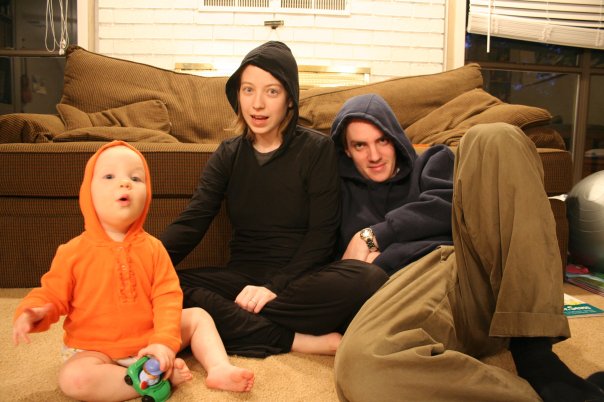
| This 2007 photo depicts my white family wearing hoodies before they had been made the scapegoat of murder. |
So many people, black and white, have already written about the murder of Trayvon Martin in Florida a month ago that I hesitate to say anything more. The national attention his parents have succeeded in drawing I hope will ensure a more serious investigation of what happened than had been done previously.
Either Racist or Not Racist?
But, to me, there is something missing from the
discussion. We talk
of whether or not George Zimmerman, the individual, is a "racist," as
though it were some secret infection like like being a vampire or a
werewolf. Or as though he were secretly had some personal affiliation
with the Ku Klux Klan; as though there was a monster he kept hidden
inside that took over and killed Trayvon.
There are great number of details emerging about this case and a lot of dispute, we can hope the investigation will clarify. But what seems clear is that Zimmerman felt threatened by the mere presence of a young black man in a hoodie, and that many many other people feel the same way. What is also clear is that many people
in the African American community deal with the devastating
consequences of this perception every day. If you're not convinced of this, I suggest you humbly ask any of your black friends or co-workers if they have ever been harrassed, threatened or mistreated by law enforcement or other figures in authority with no apparent cause other than their being black. And out that experience, it
is impossible to ignore the way that perception is key to understanding
what happened and keeping things like it from happening again.
Socially Constructed Perceptions; Individual Choices
Much of our culture, language and judicial system is
based around thinking about individuals as solely responsible for their
actions and for good reason. But, this doesn't leave us with many ways
to talk about the way that things like the perception of young black
men are created by all of us, at the social and cultural level.
All our experiences, perceptions and language together with the people
we come into contact with shape that perception.
It's not enough to
ask, "was George Zimmerman a racist?" We have to ask,
- "Where did he learn to feel threatened by black people?" And perhaps more importantly,
- "in what situations do I feel threatened? What are the main factors that cause it? Is race one of them?"
While these attitudes and perceptions are
created and come to us at the social and cultural level such that no one
person can be held responsible for them, we do still have the choice as
individuals to accept or reject them.
Questioning Our Perceptions
The next time we feel threatened
and want to cross to the other side of the street, or lock our car
doors at an intersection, we can ask ourselves
- Is the color or race of the people involved the main reason I feel this way?
- Is what I'm feeling real danger or just a phantom from my culture?
- Is this the person I want to be?
- Is this how I want my kids to be?
Until we learn
to talk about the subtle yet powerful ways these culturally created and unconsciously shared attitudes toward race shape us and our perceptions, beyond
simply labeling people or statements "racist," I'm afraid we will miss
one important lesson from Trayvon Martin's death.
The most terrifying aspect of this story to me is not the notion that Zimmerman is some kind of secret-racist monster, but that Trayvon's death is one end consequence of a perception of black men in our culture that many many non-black people, including myself, have felt, and that many black people have suffered under since desegregation and before.
Let me say that again, more strongly: the perception of fear and danger that motivated Zimmerman to pursue and kill Trayvon Martin is the same perception and fear that I have felt and it just as dangerous. Even though I'm not carrying a weapon or playing at being a police officer, I am participating in creating and passing that culture on to my children and to my community.
My culture, collectively, taught me to fear the
black stranger walking towards me on the street. But I, as an individual, I
get to choose to reject that fear as a culture that leads to death and instead choose see him as a person who might just be out for a bag of skittles and a drink.

