This is the audio from a talk I gave on Good Friday Morning at AltadenaBaptist.org for a Community Prayer Breakfast with the Joint Meeting of area Kiwanis clubs. They were very receptive and gracious to hear a talk that even began to make me nervous.
This is a live drawing I did as part of the Good Friday Service at ABC. I draw on watercolor paper with a camera feeding a projector so those present can watch. I spoke a lot about the how in Jesus, God looks back at us, through any masks we try to put on others to turn them into monsters or scapegoats. When I was finished with this rendering of Jesus on the cross, staring back, I left it up for the rest of the service. But the longer I looked at it, the more uncomfortable I was and the harder it was to meet his stare.
Showing posts with label thought. Show all posts
Showing posts with label thought. Show all posts
Sunday, April 8, 2012

Monday, March 26, 2012
My Culture Taught Me to Fear Black Men: I Choose to Reject That
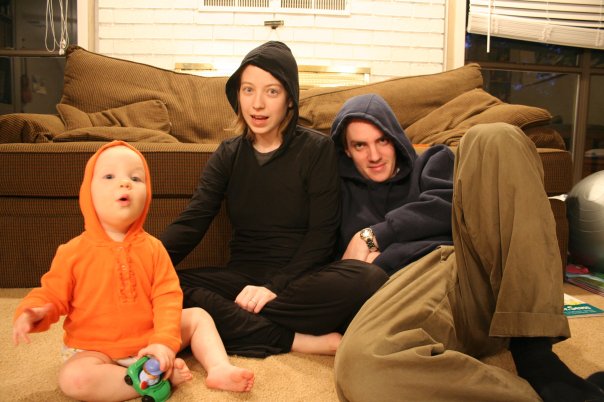 |
| This 2007 photo depicts my white family wearing hoodies before they had been made the scapegoat of murder. |
So many people, black and white, have already written about the murder of Trayvon Martin in Florida a month ago that I hesitate to say anything more. The national attention his parents have succeeded in drawing I hope will ensure a more serious investigation of what happened than had been done previously.
Either Racist or Not Racist?
But, to me, there is something missing from the
discussion. We talk
of whether or not George Zimmerman, the individual, is a "racist," as
though it were some secret infection like like being a vampire or a
werewolf. Or as though he were secretly had some personal affiliation
with the Ku Klux Klan; as though there was a monster he kept hidden
inside that took over and killed Trayvon.
There are great number of details emerging about this case and a lot of dispute, we can hope the investigation will clarify. But what seems clear is that Zimmerman felt threatened by the mere presence of a young black man in a hoodie, and that many many other people feel the same way. What is also clear is that many people
in the African American community deal with the devastating
consequences of this perception every day. If you're not convinced of this, I suggest you humbly ask any of your black friends or co-workers if they have ever been harrassed, threatened or mistreated by law enforcement or other figures in authority with no apparent cause other than their being black. And out that experience, it
is impossible to ignore the way that perception is key to understanding
what happened and keeping things like it from happening again.
Socially Constructed Perceptions; Individual Choices
Much of our culture, language and judicial system is
based around thinking about individuals as solely responsible for their
actions and for good reason. But, this doesn't leave us with many ways
to talk about the way that things like the perception of young black
men are created by all of us, at the social and cultural level.
All our experiences, perceptions and language together with the people
we come into contact with shape that perception.
It's not enough to
ask, "was George Zimmerman a racist?" We have to ask,
- "Where did he learn to feel threatened by black people?" And perhaps more importantly,
- "in what situations do I feel threatened? What are the main factors that cause it? Is race one of them?"
While these attitudes and perceptions are
created and come to us at the social and cultural level such that no one
person can be held responsible for them, we do still have the choice as
individuals to accept or reject them.
Questioning Our Perceptions
The next time we feel threatened
and want to cross to the other side of the street, or lock our car
doors at an intersection, we can ask ourselves
- Is the color or race of the people involved the main reason I feel this way?
- Is what I'm feeling real danger or just a phantom from my culture?
- Is this the person I want to be?
- Is this how I want my kids to be?
Until we learn
to talk about the subtle yet powerful ways these culturally created and unconsciously shared attitudes toward race shape us and our perceptions, beyond
simply labeling people or statements "racist," I'm afraid we will miss
one important lesson from Trayvon Martin's death.
The most terrifying aspect of this story to me is not the notion that Zimmerman is some kind of secret-racist monster, but that Trayvon's death is one end consequence of a perception of black men in our culture that many many non-black people, including myself, have felt, and that many black people have suffered under since desegregation and before.
Let me say that again, more strongly: the perception of fear and danger that motivated Zimmerman to pursue and kill Trayvon Martin is the same perception and fear that I have felt and it just as dangerous. Even though I'm not carrying a weapon or playing at being a police officer, I am participating in creating and passing that culture on to my children and to my community.
My culture, collectively, taught me to fear the
black stranger walking towards me on the street. But I, as an individual, I
get to choose to reject that fear as a culture that leads to death and instead choose see him as a person who might just be out for a bag of skittles and a drink.
Wednesday, February 16, 2011
Stanley Hauerwas at Fuller - Mental Illness: My Story

Update: Complete, uncut videos of all three of Dr. Hauerwas' talks (my notes are from the first). Don't miss out.
Friday, December 10, 2010
Re: Confessions of a Former Worship Leader

Interesting reflections, but he doesn't even address the way this is just the latest permutation of the age old debate between spontaneous worship and planned worship. You might think of the mic placement as a kind of planned liturgy. It only seems phony in the context of a tradition that presupposes deeper authenticity for "spontaneous" worship and regards planning as manipulation.
Further, you could also see the reading of the law as a use of a new technology, the written word read aloud, used to manipulate the emotions of the people, in the same way some critique the use of video in worship today. His application of Ezra's response is good, but his sense of conflict and manipulation hint at a fairly myopic view of worship. Lets all take a step back out of the microcosms of our communities and look at how worship functions globally, for all humanity, across religious traditions and across history. Only then can we discern what are the key issues for our particular context. Once you recognize that worship is something humans do, on our own terms, by our own imaginations, as a means to reaching out to God, it becomes a matter of pragmatics. What works to help us connect to God and to provide contexts for transformative encounters with God? For some that might be reading the law all day, for others that might mean an emotional crescendo, for others that might mean a tent playing trance music with visuals.
As a low-church baptist this is an easy move for me to make, but I think it's a helpful one if we want to move past worship wars and into asking serious questions about how worship functions and shapes our communities.
Monday, November 22, 2010
Face in Books

I found some books for free the library was giving away. They had nice paper so I didn't want to see them go to waste. They were a series of periodicals on the discipline of "Spiritism." At the turn of the century what is now seen as fringe science was still being studied and was on the same edges with psychology such that even a Christian School of Psychology might want them in its library's collection.
No more. The current boundaries of the possible have little room for spirits. Charon makes an appearance because I was reading Dante's Inferno for Dr. James Bradley at the time I drew these. The more I read that book the harder I find it to take him seriously. It continues to fascinate me how natural an expression that work is of an attempt to reconcile a pre-christian "pagan" worldview with with the Christian present. It fascinates me all the more because I think this process of reconciliation and the blending of narratives and ascribing new meaning to old patterns is at the heart of how we change our minds and migrate from one life-world to another.
Monday, October 18, 2010
Why I Grieve It

And so Bazan wrestles - with himself, with his audience, and with God.
And he grieves what he has lost. At the show Friday night, Bazan and band played the Pedro the Lion song "The Fleecing." The song used to sing,
I could tell you why I doubt itAnd why I still believe itAnd why I need itAnd what the Pharisees don't see
Friday night, Bazan sang instead,
I'd tell you why I doubt itAnd why I don't believe itAnd why I grieve itHow I was blind but now I see
As he sang these words on the edge of everything in Silver Lake at Spaceland, many present cheered. Many others sighed - in confusion, in commiseration, in love.
///
Elijah, thank you for so carefully explaining the heartbreaking moment when, in changing the lyrics, Bazan stopped speaking for me and started speaking for the guy in the plaid shirt in front of me (pictured here) who cheered and clapped to find in Bazan such a kindred spirit.
I suppose it's only fair I have to share. I've been able to count on Bazan for the last ten years to give words to my own struggles, to the challenge to reconcile faith with the wrongness of the world and the suffering of so many at the hands of the church. And I couldn't want for anything other than the fierce honesty that has made Bazan's writing so strong. But it still makes me sad to loose him. I guess that's why my hand shot up when he asked for questions right after the song you quote and I asked: "How do you grieve it?"
"How do I grieve it? How do you grieve anything? You take the process seriously..."
You can only grieve what's lost. If "Curse Your Branches" was Bazan's break-up record with God, then this concert was my "break-up" with Bazan.
I think I'm grieving it.
Saturday, August 14, 2010
A Note for Americans (and for Christians) About the Proposed Manhattan Mosque
View Larger Map
I don't generally consider blogs to be an ideal forum for charitable conversation, however, I feel so strongly about this I feel compelled to say what I think and offer to read your responses with the same grace and charity which I hope you will extend to my words.
For Americans:
Whenever people and nations go through traumatic times they face a choice. How do we integrate what has happened into the rest of the story of our lives? Do we let it make us angry and afraid? Bitter and reactionary? Or do we find a way to weave our hard and painful experiences it into the arc of who we have been and who we want to be?
After 9/11 all Americans faced this choice and we continue to face it today. I understand that the suffering, trauma and loss of both the families who lost loved ones and the rest of America is real and painful, even today. But we must choose not to be defined by that experience.
As we consider who we as a nation have been and would like to be in the context of the proposed Muslim Community Center in Manhattan, we can turn to the story of what America has been in the past: a place where, just up the coast in Boston and Providence people journeyed across oceans to carve out a space for themselves and their families to live out their faith in accord with their own consciences, free from the interference of the religious and political majority who had not let them worship as they wished or build churches where they wished.
This is why I agree with President Obama that this is an issue of freedom of religion that goes back to the core of who we have been as a nation. We now get to choose:
Will we let 9/11 change who we have been, because we still live with the scar of ground zero? Or will we remember who we have been, join our future to our past and demonstrate that we can live out what we claim to believe.
--
For Christians:
I have intentionally not made any arguments from within my own Christian faith. This is because I believe this question is a live one for all Americans, not just Christians. That said, we as Christians may want to consider what our Lord's command to love our neighbors as ourselves might suggest in this case.
Thursday, July 8, 2010
Sign Your Name Please

I was having a conversation last week with the editor of the Burner Blog about how much I dislike it when group-edited blogs use a generic signature on posts. I used the CTI blog Out of Ur as an example.
If I read your blog regularly, I develop a relationship with your editors and learn their voices, paying special attention to my favorites. This process of me bonding with your content creators is frustrated when you obscure their name from me. Also, it keeps me from finding other stuff on the web that they have written that I might enjoy and inhibits their professional development.
Finally it contributes to the notion many people have carried with them from the earliest years of the internet, that somehow what you write and who you are on the web are separate from who you are in real life. Most of us have changed our email addresses from goofykid1776@hotmail.com to something resembling our real name. I suggest that we carry the same idea forward in our blogs and sign our name to what we write, and if that feels uncomfortable, then it might be time to reconsider what we have written or where we are posting.
Saturday, February 20, 2010
Open and Closed Case

WHY OPEN MATTERS
Lately I've been having entirely too much fun playing with the real-time sample cutting/cueing software called mlrV (see it in action below here). mlrV was built to run on the monome (pictured here): an open source hardware project (all the specs and circuits are freely available and no attempt is made to protect intellectual property) that runs open source software written in a special audio-programming environment called MaxMSP.
The monome is hard to explain because it doesn't do anything on its own out of the box. It is a sound controller. It provides a physical interface to control what a computer does with sound. It's just a grid of buttons with lights under them.
But the open-endedness of the project is also its strength. mlrV is only one of dozens of powerful programs, written by scarily intelligent and talented music-nerds posted and supported for free here. Such is the power of open source software + open source hardware.
To make my point further, I don't even own a monome. They are in such high demand that they sell out in seconds after they go on sale despite their $500-$1000 price-tags. I couldn't find one to buy. But last November a British company called Novation built this sound controller called the the launchpad.

Look familiar? It's made to control another more comprehensive, expensive and wonderful software called Ableton Live. Also it costs less than half of the price of the cheapest monome because it's mass-produced in China instead of lovingly hand-crafted in the Catskills.
This is open development at its best. Not simply because I got a powerful tool for free or more cheaply (though this is a common outcome) but because the creators were willing to let the cultural/creative process happen without trying to lock it down so they could make more money from it. There is a willingness to prioritize the broader cultural or community benefit over individual financial gain. You either love music more or you love money more. Apparently the people behind the monome love music more.
WHAT CLOSED MEANS
Also tonight, I was reading an a post (on my iPhone) from a blog called Create Digital Music. The author was arguing that Apple's new iPad while very shiny and cool, is ultimately a step in the wrong direction. I've heard these arguments before but tonight I became convinced. And it has everything to do with control.
First: control of the software. Apple's made no secret of controlling who gets an app in their store and often they block good apps for no good reason and let in thousands of bad apps. But it's the apps (like this life-changing one) that make the iPhone such a useful and interesting device. The size, connectivity and touch-screen have changed the way we use computers, despite Apple's capriciously run app store.
Second: control of the hardware. I have spent a good 3-4 hours total attempting to restore to working order a perfectly good iPhone a friend of a friend gave to me. The problem is that he tried to "jailbreak" the phone so he could run apps other than the ones Apple sells in its store. Normally if a computer's software gets messed up you would just reset the phone back to factory settings ("restore" in iTunes). But because of the escalating war between the people who find ways get around Apple's tight control over their phones, and the people at Apple who then create more ways to maintain control, this is no longer possible.
Now if you want to restore your phone in iTunes (even if you haven't attempted to "jail-break" it), iTunes has to check the software and your hardware against its records on a server somewhere they control. If they don't like the software you're using to restore it, or if they think you have restored it too many times, or in a suspicious way, they terminate the restore process remotely.
Days after the launchpad was released a clever hacker wrote a piece of code in MaxMSP that lets the launchpad use (almost) all the free open-source software written for the monome. The response of the people who make the monome? "Good work. We love what you're doing to expand the project."
This is open development at its best. Not simply because I got a powerful tool for free or more cheaply (though this is a common outcome) but because the creators were willing to let the cultural/creative process happen without trying to lock it down so they could make more money from it. There is a willingness to prioritize the broader cultural or community benefit over individual financial gain. You either love music more or you love money more. Apparently the people behind the monome love music more.
WHAT CLOSED MEANS
Also tonight, I was reading an a post (on my iPhone) from a blog called Create Digital Music. The author was arguing that Apple's new iPad while very shiny and cool, is ultimately a step in the wrong direction. I've heard these arguments before but tonight I became convinced. And it has everything to do with control.
First: control of the software. Apple's made no secret of controlling who gets an app in their store and often they block good apps for no good reason and let in thousands of bad apps. But it's the apps (like this life-changing one) that make the iPhone such a useful and interesting device. The size, connectivity and touch-screen have changed the way we use computers, despite Apple's capriciously run app store.
Second: control of the hardware. I have spent a good 3-4 hours total attempting to restore to working order a perfectly good iPhone a friend of a friend gave to me. The problem is that he tried to "jailbreak" the phone so he could run apps other than the ones Apple sells in its store. Normally if a computer's software gets messed up you would just reset the phone back to factory settings ("restore" in iTunes). But because of the escalating war between the people who find ways get around Apple's tight control over their phones, and the people at Apple who then create more ways to maintain control, this is no longer possible.
Now if you want to restore your phone in iTunes (even if you haven't attempted to "jail-break" it), iTunes has to check the software and your hardware against its records on a server somewhere they control. If they don't like the software you're using to restore it, or if they think you have restored it too many times, or in a suspicious way, they terminate the restore process remotely.
The net outcome is that I have a perfectly good piece of hardware on my desk the software of which is still being controlled by the company that made it, even though it has already been bought and has changed hands three times. The simple reason is that if they can retain control they can make more money. Apparently they love money more than they love the cultural/creative process that is the development of technology: hardware and software.
Sunday, January 24, 2010
The Mysteries of Market Analysis

I finished college with money left over from what my mom saved for me to go to college. I've kept that money invested in mutual funds with a company called Edward Jones since then. Lately my "financial advisor" (the guy who gets a commission from everything I
invest) has been sending me risk assessment reports like the one below. I read the intro and conclusion. It's like peering through a strange mirror.

It's hard for me to imagine the vast networks of humans whose job it is to take something like the election of Senator Brown or healthcare reform and distill it down to probabilities of how the medical sector will perform as an industry.
This probably just further illustrates how naive or isolated I am from the economic reductionism that drives so many crucial decisions in our society. But the contrast is so stark between this way of viewing the world and that of the Seminary world I am immersed in. This strikes me as either a problem or an illustration of the alternate vision of reality faithfulness to Jesus calls us to live. Either way, the manner in which this document strikes me as bizarre suggests that I need to get out more, if only to better know the dominant narrowness of scope I need to challenge.
Subscribe to:
Posts (Atom)
